Why Self‑Care Is a Positive Parenting Strategy, Not a Luxury
The Hidden Truth: Kids Feel What We Feel
We often hear “put your own oxygen mask on first,” but in real life it can feel unrealistic or even selfish. Yet research consistently shows that children are deeply attuned to their caregivers’ emotional states. When parents are overwhelmed, exhausted, or stretched thin, kids pick up on it — and their behavior often reflects it. This is why self‑care isn’t indulgence. It’s positive and preventative parenting.
What Self‑Care Really Means (Hint: NOT Spa Days)
Self‑care is less about manicures and more about:
- Nervous System Regulation Tools — a deep breath before responding, a quiet cup of tea, a 10‑minute walk, waking up a little earlier, anything that helps expand your Resilient Zone and ability to handle the day-to-day ups and downs.
- Practice looking for Tiny Little Joys, as explained by Dr. MC McDonald, “this is a practice that rewires our brains towards resilience and away from stress and anxiety,” acknowledging that even tiny little moments of joy can and will exist alongside the challenges or chaos.
- Knowing your limits and setting boundaries — saying no to commitments that might be above and beyond what you are able to do with your current load.
- Organizing a schedule or routine – creating a plan for the day that helps everyone prepared for the day ahead, that may include meal plans that are simple and practical, but that help mealtime more enjoyable and less stressful.
- Asking for help — from partners, friends, or community resources. If you’d like extra parenting support, you can sign up for free parenting classes.
- Prioritizing sleep and nutrition — the basics that make everything else possible.
These small habits build emotional bandwidth — the fuel you need to stay patient, consistent, and connected.
How Self‑Care Improves Parenting Outcomes
When parents take care of themselves, they’re more likely to:
- Respond calmly instead of react with anger or frustration
- Use positive discipline strategies more effectively
- Model healthy coping skills
- Create a calmer home environment
Kids learn emotional regulation by watching us. When they see us pause, breathe, and take care of our needs, they learn to do the same. Neuroscientists refer to this as mirror neurons.
A Simple Self‑Care Plan for Busy Parents
Try this three‑step approach:
- Identify your stress signals — rushed mornings, over-scheduled evenings, fatigue, feeling unprepared.
- Choose one daily reset ritual — something small and repeatable – time in nature, journaling, yoga or walking, creating a new plan or schedule to make things go smoothly.
- Communicate your needs — “I’m taking five minutes to reset so I can be more present and grounded.”
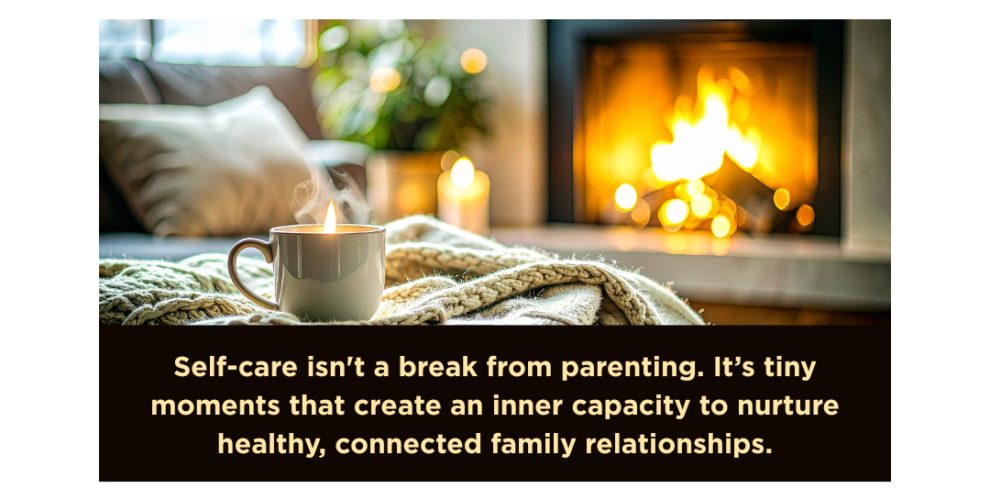
Self-care isn’t a break from parenting. It’s tiny moments that create an inner capacity to nurture healthy, connected family relationships.